Thursday, April 14, 2016

Unemotional Communions

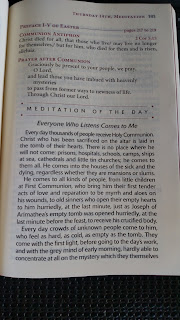
Everyone Who Listens Comes to Me
by Caryll Houselander


"I especially like this part: "In the eyes of the world they are without importance, but in fact, because of them and their unemotional Communions, when the world seems to be finished, given up to hatred and pride, secretly, in unimaginable humility, Love comes to life again.  There is resurrection everywhere."

You can find the whole Meditation in Magnificat, April 2016, Vol. 18, No. 2, pages 185-186

Tuesday, October 14, 2014

Purposeful Trial

Keep in mind...

(From the Catechism of the Catholic Church)

The Church's ultimate trial
675 Before Christ's second coming the Church must pass through a final trial that will shake the faith of many believers.574 The persecution that accompanies her pilgrimage on earth575 will unveil the "mystery of iniquity" in the form of a religious deception offering men an apparent solution to their problems at the price of apostasy from the truth. The supreme religious deception is that of the Antichrist, a pseudo-messianism by which man glorifies himself in place of God and of his Messiah come in the flesh.576
676 The Antichrist's deception already begins to take shape in the world every time the claim is made to realize within history that messianic hope which can only be realized beyond history through the eschatological judgment. The Church has rejected even modified forms of this falsification of the kingdom to come under the name of millenarianism,577 especially the "intrinsically perverse" political form of a secular messianism.578
677 The Church will enter the glory of the kingdom only through this final Passover, when she will follow her Lord in his death and Resurrection.579 The kingdom will be fulfilled, then, not by a historic triumph of the Church through a progressive ascendancy, but only by God's victory over the final unleashing of evil, which will cause his Bride to come down from heaven.580 God's triumph over the revolt of evil will take the form of the Last Judgment after the final cosmic upheaval of this passing world.581


[Note to self: The path to Resurrection is always through the Cross.]

Monday, October 13, 2014

Bible Gateway Verse of the day

For I know the plans I have for you,” declares the Lord, “plans to prosper you and not to harm you, plans to give you hope and a future. - Jeremiah 29:11 http://www.biblegateway.com/passage/?search=Jeremiah29:11&version=NIV

Wednesday, April 30, 2014

Wisdom Stories

Starting to read Margaret Silf's One Hundred Wisdom Stories.  The first one is not much more than a page and is titled "A Beautiful Friendship.".   It made me smile. 

I hope to read only 1 or 2 of these a day.  I want to savor them!

Thursday, April 24, 2014

Screwtape Letter 21

I'm reading C. S. Lewis' Screwtape Letters, all of which are immensely interesting.  Number 21 demands a comment! First, read this portion of the letter:

The joke is that the word "Mine" in its fully possessive sense cannot be uttered by a human being about anything.  In the long run either Our Father or the Enemy will say "Mine" of each thing that exists, and especially of each man.  They will find out in the end, never fear, to whom their time, their souls, and their bodies really belong -- certainly not to them, whatever happens.  At present the Enemy says "Mine" of everything on the pedantic, legalistic ground that He made it; Our Father hopes in the end to say "Mine" of all things on the more realistic and dynamic ground of conquest.
Your affectionate uncle
Screwtape

Keep in mind that Lewis is writing these "letters" in the voice of "Screwtape" who is a demon.  So everything Screwtape says is from the perspective of demons; "Our Father" is Satan, and "the Enemy" is God.  Prior to the paragraph quoted above, Screwtape has been teaching his "dear Wormwood" about humans' tendency to believe their time, amongst other things, is their own, and how Wormwood should try to keep the soul assigned to him believing this illusion.  Wormwood can use this for the devil's purposes because "Men are not angered  by mere misfortune but by misfortune conceived as injury.  And the sense of injury depends on the feeling that a legitimate claim has been denied." (from the second paragraph of the same letter.).

In other words, if we humans believe our time is our own and then have some of it taken up by others in activities undesirable to us, we will naturally feel angered or at least irritated by these impositions.  The devil can then use this sense of injury and subsequent irritation to distance us from God. 

However, I would note that the devil lives under his own illusions: he is in continual denial that Jesus Christ has over-come all obstacles that could separate us from God.  We do indeed belong to the Lord (whether we like it or not) and we will meet Him face to face, bowing the knee and answering for our lives.  Coming face to face with Christ we will have all illusions shattered. If we are alive in Christ, we will be glad to be freed of them.

My personal prayer is that the Lord grant me the grace to gratefully discard any and every illusion in this life well before judgment day!  My experience is that the Lord's love for me is so lavish, He does this gradually and gently, allowing me to exercise my fiat, providing me the opportunity to freely and truly love Him above all else.

For the times I choose to remain blind,
Lord have mercy.
For the times I resist You,
Christ have mercy.
For the times I am slow to yield to You,
Lord have mercy.

May the Lord have mercy on each of us and grant us the grace to say Yes to His Love.
Lord, it is only by the help of Your Holy Spirit that I can seek You and find You and say Yes to You.
Praise be Thee that You actually persistently seek and find us!
Blessed be the Name of the Lord now and forever.
Amen.
 

Wednesday, April 23, 2014

Screwtape Letters

Currently reading Screwtape Letters by C.S. Lewis.  It helps me think.

Friday, March 14, 2014

Re-reading The Gospels

Notes on Reading the Gospels

Mark

What stands out: 
Fast-paced action.  Breathless, exuberant witness.  Jesus' delivery: plain speech, voice of authority.  I appreciate Mark's exuberant testimony which gives us a sense of how astounding was the fresh and unequivocal authority of Jesus' teaching, and I delight in how excitedly Mark describes the apparent fast-paced action of all that Jesus did. I too feel the awesome new-life-giving power of all that Christ does, and the uniqueness of His authority.  I also like how emotionally the drama is depicted; even though (or maybe because)  much of the writing seems rough-hewn, I find myself easily in the scene: I feel the human emotions of being confronted by the status-quo-disrupting, awesome-and-terrifying, saving grace of my Lord and Savior.

Challenges to discipleship:
One of my favorite Gospel stories is the one of the woman who had been bleeding for twelve years (Mark 5:25-34).  I am profoundly grateful for her pro-active faith which led her to courageous initiative.  Her reaching out to touch the hem of Christ's cloak, despite the fact that in her society women were not to touch men, and the sick or "unclean" were not to "defile" the "clean", encourages me to reach out to Christ in faith in any and every circumstance.  Jesus rewards her for her faith-filled-action; He heals her.  This is empowering for me as well.  I believe Christ calls each of us not only through the faith-community, but also through our very personal need of Him.  Sometimes we have to reach out, sometimes even being the first to challenge institutionalized societal mores or customs, crossing the man-made boundaries that might leave us bleeding, out-cast, or captive.


Matthew

What stands out:
If someone were to tell me I will be stranded on a desert-isle for the remainder of my life and I can take only one book, I would choose the Bible.  And were they to say, you can only take part of the Bible, I would say "give me the Gospels and the Psalms.". Were they to say no, you can take only one writing, I would likely choose one of the Gospels, but it would not be Matthew!  Of all the Gospels I find this the "driest.". The action-packed drama of Mark sweeps me off my feet; the canticles and lyrical writing of Luke, particularly the revelation of the Healer's heart, appeals to my soul; my spirit feeds on the deep theology of John; but Matthew requires of me a greater effort to attend, to "seek and find".  This is apropos inasmuch as this is his main theme: the Kingdom of God is at hand, and we are to seek it and find it and most of all, to do it!  I also find a kind of harshness or asceticism in Matthew that seems more pronounced that any similar teaching in the other Gospels.  In this context, Matthew 11:28-30 is all the more sweet and nourishing:  "Come to me all who are weary and heavy-laden, and I will give you rest.  Take my yoke upon you, and learn from Me, for I am gentle and humble in heart; and you shall find rest for your souls.  For My yoke is easy and My load is light."

Challenges to discipleship:
I find it remarkable that while Matthew addresses an audience of faith-instructed, tradition-holding, Jewish Christians, he is the most critical of the Jewish leaders of his time.  I find myself thinking were Matthew to write today, he would write similarly to us, particularly the western-culture-enmeshed Christians and our Church leaders.  I don't hear Jesus' chastisements as against the Jewish religion, but rather against any instance of self-righteousness, against using any gift from God as an excuse to turn away from serving or sharing with our neighbor (and our "enemy.")  Matthew proclaims the Kingdom of God is at hand, but it is an upside-down Kingdom, where the first shall be last and the last shall be first, where all the lost and lacking are happy (see the Beatitudes) because they are fed and clothed by the King Himself, Who lays down His own life for them while they are yet tardy workers and sickly sinners.  For me, chapter 16, verses 24-27 convey the main message of Matthew; essentially to enter this Kingdom of Life, one must die to self; i.e. to be a disciple of Christ, one must follow Him to and through the Cross.


Luke (and Acts)
What stands out:
The Holy Spirit coming to us and guiding us.  God is generous.  Journeys.  Meals.  Prayer.  Healing. Intimacy.  Luke shows Christ's concern for the lowly: the sick, the poor, women, children, out-casts. 
Four of my favorite passages in Luke are 1) Luke 2:1-20, especially the part about the angels appearing to the shepherds; 2) Luke 10:38-42, regarding Mary and Martha; 3) Luke 15:11-32, the parable of "the prodigal son;" and 4) Luke 24:13-35, the account of those on the road to Emmaus.  The 1st is a good example of how Luke shows God's generosity to the lowest of society, the shepherds, giving them the glorious good news of the Savior's birth.  The 2nd teaches us that Jesus wants personal intimacy with each of us. The 3rd makes marvelous use of all these themes, with a dramatic revelation of the Father's astounding generosity and amazing, unconditional love.  The 4th is a consummate example of the themes of journey, and revelation of the Lord and intimacy with Him through breaking of the bread and prayer, as well as the healing of restoration of community through faith-sharing. 

Challenges to discipleship:
Luke shows us a compassionate and forgiving Savior.  At the same time we are called to radical discipleship to Christ.  We are challenged to give up all we have and all we are (Luke 12 and 14:25-35).  What stands out to me in the book of Acts is the power of the Holy Spirit at work in those who truly believed (as in trusted and lived) on the Lord Jesus Christ with their whole heart, mind, and body.  The stories that demonstrate this for me are: Acts Chapter 2 regarding the day of Pentecost;
Chapter 4: 32-37 regarding the sharing of everything among the believers; Chapter 7: 55-60 Stephen's ability to forgive while being stoned; Chapter 9: 1-19 Saul's conversion and Ananias' faith in the face of danger and the naturally-impossible; Chapter 10 Cornelius' conversion and Peter's further conversion through the initiative of the Holy Spirit; Paul's passionate perseverance in faith through many trials to the very end.  All of these stories show me that the Holy Spirit wants to do radical things, and will move where-ever God wills, even when we are stuck in human conceptions about what should be.  In all these stories, it is the Holy Spirit that initiates.  The Lord uses those who respond by yielding to the Spirit. 

This to me is amazing, glorious, and reassuring.  My own experience of this world is that human systems tend to become corrupt, eventually perpetrating some form of injustice even if that wasn't the original intent of the founders or maintainers of the system.  I also experience many individuals as bullies or tending to operate out of a profoundly self-centered mentality.  I.e. God didn't give me any form of worldly armor.  I identify with the little ones who are forgotten or run over in many situations, while others fight for something "big" but "of this world.".  I daily experience the vulnerability of being a human creature, wholly dependent upon my Creator for any good thing.

The accounts in Acts show me that God is bigger and God is more powerful than anyone or anything of this world, even if He chooses not to take up the "fight" according to the world's rules of engagement.  The Lord's ways are completely Other than human ways; and yet, He invites us to enter into His Life and to co-operate with His Will.  To accept this invitation to radical discipleship, we must completely trust the Lord with our entire life; we must accept suffering; we must seek, find, and accept the Life that is ours in Jesus Christ by way of the Cross.  And even that we can't do, unless we accept the Holy Spirit as the One "in whom we live and move and have our being.".

John
What stands out:
No matter how many times I read the Gospel of John, I am struck by the beauty and majesty of the opening profession of faith (John 1:1-18), "In the beginning was the Word, and the Word was with God, and the Word was God...". This prologue alone would be enough for me to meditate and feed upon for many a year.  Everything in John's account meets me as awesomely profound and majestic, but at the very same time draws me to want and receive deeper intimacy with my Lord, Jesus Christ.

Challenges to discipleship:
The thing that strikes me about the Gospel of John is that over and over again in so many ways, the question is asked "who is Jesus" and we receive the answer, from Jesus Himself, or from witnesses: He is Lord, He is the Word, He is the Christ, He is God.  However, with this most recent reading, I am noticing that every time Jesus tells us Who He is, we also learn something of who we are.  If Jesus is the Word, I must be the one who hears (and obeys).  If Jesus is the Light, I must be the one who sees (and acts).  If Jesus is the Truth, I must assent to faith in Him.  If Jesus is the Good Shepherd, I must follow Him with complete trust and dependence upon His provision and guidance.  If Jesus is the Vine, I, as a branch, must bear fruit -- His fruit, not mine, not something I conjure up, but whatever He gives me to bear.  If Jesus is the Messiah, the Lamb of God, I must find my life in Him, accept His salvation in the way He gives it, which is to die with Him and abide in Him through death and resurrection.  If Jesus is my Creator and Lord, I must completely yield to Him, gratefully worshipping Him and yielding to His "finishing and perfecting" me in faith.

Personal Note
At the time I am writing this, I have received the devastating blow of losing my ministry-position at the place where I am employed.  Due to the need for the institution to down-size, my role and my wages have been reduced to stipend-per-select-work, and no support for all the supporting work that makes the primary work do-able, at least in any excellent way.  This is a catastrophic reduction in livelihood for me.  I feel betrayed by the people of this organization.  I am having a hard time discerning how the Lord wants me to respond.  Does He want me here, to persevere in the face of chaos and apathy?  Or is this a blatant call to go elsewhere?  Does He want me to step away from everything and accept a completely new path?  I'm trying to let the Holy Spirit speak to me through the reading of The Word and my reflection upon it.  Even while I make the observations I have (above), I am not yet able to see how they practically apply to my life right now.  My heart is in agony because I don't know how to proceed. 

During the meditations on the Stations of the Cross, I find it easy to identify with the passages about "I look about me and there is no-one to lend me aid..."

The only thing I can perceive right now is that maybe the Lord doesn't want to allow anyone else to help me because He wants to be my Sole Friend and Savior in every detail.  (Sole and Soul.  Yes, I know.).  I think this kind of thinking is potentially dangerous.  I dare not assume I am the author or determiner of how God wants to care for me.  God can use others or not.  God can vary how He works.  God is not bound by anything, except Himself; He is Love; everything He does is Love.  I still believe completely in God, Who He Is, and that He Is With me.  I just don't know any of the details right now.  And that gives me anxiety. 

Lord, Holy Spirit, please fill my heart with You.  I don't even ask for any particular thing or feeling or perception or thought or direction; just fill me with You.  Let "just" You be enough for me.

The Lord giveth; the Lord taketh away; blessed be the Name of the Lord.
Amen.
 

Monday, November 11, 2013

Re Liturgy

Praise the Lord, O my soul,
Let all that is within me praise His Holy Name!

Glory be to the Father, and to the Son, and to the Holy Spirit!
As it was in the beginning, is now, and ever shall be, world without end.
Amen.

Lord-God, I thank You for all the ways You have given us to give You worship and praise.  Thank You especially for giving us the means to commune with You, most especially in the Celebration of the Eucharist.

Receiving You in the Celebration of the Eucharist is indeed "the source and summit" of my living.  Thank You Abba for Jesus.
Thank You Jesus-Christ for all You have done to make it possible for me to Live in You, and for sending us Your Holy Spirit.
Thank You Spirit for Your ever-faithful Presence; please guide me and guard me until I reach Heaven, my true Home.

Praise the Lord forever!

Wednesday, November 6, 2013

Victory In Christ

USCCA, Chapter 13
I believe in the resurrection of the dead, and life everlasting.  I believe Christ's death and resurrection means He has saved everyone from their sins and from the power of death.  However, for each person to enjoy eternal life in Christ, they must accept His self-giving love, His Life. 

Exactly when and how the Lord will execute the Final Judgment, I don't claim to completely know or understand.  I do know that because I live in Christ, I can trust Him for my eternal destiny.

Lord I pray for every human-being that has ever lived, that lives now on earth, and that will yet be born.  I pray that Your mercy on them will be experienced by them in coming to recognize and receive Christ.  Lord, forgive us for all the times we make it difficult for each other to see Christ.

Lord, have mercy.
Christ, have mercy.
Lord, have mercy.


Thanks be to God Who gives us the victory in Jesus Christ!

Blessed Is She Who Has Believed

USCCA, Chapter 12
Re Mary

I joyfully and gratefully recognize the sacramental relationship between Eve, Israel, Mary, Church, and yes, me!  God wants my fiat too! 

  45 And blessed is she who believed that there would be[e] a fulfillment of what was spoken to her by the Lord.”

Thank You, Lord, for all the ways You bring us Christ.  Thank You especially for Mary's profound and complete willingness to be Your "handmaid".  Her perfect trust in You both humbles and nourishes me. 

Hail Mary, full of grace!  The Lord is with thee.  Blessed art thou amongst women, and blessed is the fruit of thy womb, Jesus!

And blessed am I because of your Yes to God! :)

Four Marks

Four Marks

USCCA, Chapter 11
The four marks of The Church are:
One
Holy
Catholic
Apostolic

1st, by "The Church," we mean the entire Body of Christ, not just Roman Catholics.
2nd, by "Catholic" we mean "universal;"  this makes the first point clear.

I think that recognizing, acknowledging, and embracing the Truth of these "four marks" gives us a great context of humility!  If we really believe we ARE One, Holy, Universal, and connected with the First Believers, how could be act disrespectfully toward one another?

Pilgrim Flock

USCCA, Chapter 10

My preferred images of The Church are sacramental and relational:
The Body of Christ
The People of God
Pilgrim
Mother
The Sheep of the Good Shepherd

The image that most resonates with me at this time in my life is Pilgrim.  I see us as on a Journey Home.  Heaven is our Home, and Earth is mostly a desert where we wander, and yet, because the Lord loves us and never abandons us He provides us with Manna, with Life-giving Water, with oases along the way; and He "pitches His tent with us."  :)
 

One For All, All For One

USCCA Chapter 9
First, I need to review: 1) What are the GIFTS of the Spirit, and 2) What are the FRUITS of the Spirit, and 3) How do they relate?  [Also, do I know what Spirit Gifts the Lord has given me?]

GIFTS
Knowledge
Wisdom
Prophecy
Faith
Healing
Working Miracles
Discerning Spirits
Speaking in Tongues
Interpreting Tongues
(I Corinthians 12:7-11)


Knowledge
Wisdom
Understanding
Counsel
Fear of the Lord
Fortitude
Piety
(Catholic Catechism)


FRUITS
Love
Joy
Peace
Long-suffering
Kindness
Goodness
Faithfulness
Gentleness
Self-control
(Scripture)

Love
Joy
Peace
Patience
Kindness
Goodness
Long-suffering
Mildness
Faith
Modesty
Continence
Chastity
(Catholic Catechism)

No wonder I'm confused!  Catholics and Protestants count and name them differently!

At any rate, I believe the relationship between the Gifts and the Fruits is this:  every Christian receives one or more Gifts and they are meant to be used in service to the whole Body of Christ; the fruits should be evident in every Christian, at least eventually, as they grow in Christ; i.e. the Spirit's Gifts produce the Fruits.

I believe I have been given the Gifts of Faith, Prophecy, and Discernment of Spirits.  (By Prophecy I mean that I can see where things are leading, I have long-distance spiritual vision; I don't mean the even more rare gift of foretelling the future.)  In Catholic terms, I think these would be Fear of the Lord, Counsel, and Wisdom; although, I'm not sure the definitions of each are exactly the same.  I'm just naming, according to the lists, which Gifts I believe I've been given.

Which of the Fruits does my life reveal?  Hmm... I think, by God's Grace, my life exhibits all of them from time to time, however, I definitely struggle with each of them at times as well!  Thanks be to God for His Grace!  Thanks be to the Lord for His long-suffering continence!!!


Friday, October 18, 2013

Faith is a Gift

In response to USCCA, Chapter 8 Discussion Questions:
I've written a response to Question 1 for another venue, so I will wait to post that here until another day.  Meanwhile, re Questions 2 & 3:

How could I help someone come to faith in the Resurrection of Christ?  I don't think it really works that way.  I think that the Holy Spirit gives the gift of Faith.  Christ's Resurrection is something beyond human reason; the only way it is truly grasped is by the gift of Faith, given freely by the Spirit.  The way I can be used by the Spirit in that work is analogous to tilling soil.  I could till the soil, but the Spirit plants the seed.  The primary way I am to "till the soil" is by living a life transformed by the Spirit, especially by caring for others.  Another way I can "till the soil" is by sharing The Word (Scripture) with others.  Another way that is very accessible to me is that I can support others' in their growth in their faith life.  But the real work is done by the Spirit: giving the Gift of Faith.  For those who resist this Gift, I can pray the Lord to have mercy and to persist in making their lives "soil" capable of receiving the "seed."  This is a hard thing to pray because I am well aware that usually this involves some sort of tragedy or hardship.  People who have resisted the Gift of Faith in Christ tend to be hardened against receptivity.  It usually takes a life-altering event to bring about any review of their world-view.

There might be many ways a person comes to understand their need for a Savior, but the main way I experience this need is by encountering my own limitations, particularly my inability to forgive and to heal without the special working of the Holy Spirit.

"Why (/how) are the Cross and the Resurrection bound together in the Paschal Mystery?"
You can only rise to new life when you die to the old.
 

Wednesday, October 9, 2013

Longing for the Lord

Responding to USCCA, chapter 7: The Good News: God Has Sent His Son, For-Discussion Questions

The questions as written don't excite me!  "Why is it important to appreciate the truth that...", "what is the value...in appreciating...", and all such language is so oriented to analysis, words, thoughts ABOUT the Lord, and all with an emphasis on Revelation ABOUT God's PLAN for our salvation.  While everything the questions here infer is correct, they don't point to or evoke from me the call from Jesus Christ to become alive IN Him.

I would rather ask:
How have I experienced Jesus as my Savior and Lord?
How does my life show I have died to self and live in Him?
How have I experienced Christ's divinity and His humanity?
How would my life be different without Christ?
How does unity with God through life in Christ lead me to love all people?
How am I currently challenged to allow Christ to be more completely my Lord?

I need to write my biography!  To answer these questions with the fullness that delights me (because in so doing I celebrate God's grace to me), I would have to write many pages.  Someday I hope to do that.

For now:
My soul longs for Thee, my Lord; please grant me the grace to long for Thee ever more and forever more.  Amen.

Monday, October 7, 2013

Romans 5:20

Reading USCCA, Chapter 6: Man and Woman in the Beginning

I believe I am created by God in God's Image.  I believe each and every person is specially created by God in His Image.  What this means to me is first of all that God celebrates His own Goodness and Truth by expressing Himself in all of His creation, and especially in the Personhood of each human-being.  I am designed by God to be capable of knowing Him, wanting to know Him, relating with Him, and finding my Being in loving relationship with Him.  The Lord-God (Father-Son-Holy-Spirit) has willed me into being because God is Love, and Love enjoys the fruitfulness of giving life.

I believe that when we sin, we mar that image of God, and we distort our own being, who God designed us to be and become.  I believe that the Original Sin of Adam and Eve caused the biggest mar/wound/breach/broken-ness.  But the amazing thing about God's Love is that Love can take the materials of evil, sin, broken-ness, etc., and use it for an even greater Wholeness-in-Him: redemption.  Jesus-Christ's work of Redeeming all people by becoming enfleshed, living as a man, dying on the Cross, resurrecting from the dead, and ascending into Heaven, was no after-thought.  This self-giving on God's part, most fully expressed in Jesus-Christ, was always part of God's God-ness.  God IS self-giving.  God IS the initiator.  God creates.  God redeems.

I think most of the people I know who might reject or struggle with the idea of sin do so because they have attached their concept of themselves to that first sin, like Adam and Eve, of believing they can know Truth apart from God, and that they can have life apart from their Creator.  I think a "First Humility" is required to be born again, to recognize God, and to accept His Grace.  I think this "First Humility" is within our very essence as creatures.  God formed us from the earth, humus...  I'm not talking about any sort of piety or circumstantially imposed baseness; I'm talking about the very fact that we are creatures.  As creatures, we can't really know anything in Truth (i.e. w/out distortion), until we know ourselves in relation to our Creator.    If we deny the Creator, the idea of sin makes no sense.  If we are the authors or designers of our lives and context, then any notion of morality has to be relative to ourselves.  Sin implies we have a relationship with Someone to Whom we are accountable.  There might be other reasons people struggle with the idea of "sin" or especially in thinking of themselves as "sinners," but for most of the people I personally know who struggle with this, it's because of what I would call an "intellectual sin;" at some point in their lives they embraced the deceiver's lie that God need not be our starting point, that we can explore and learn apart/without God.

That some people believe they can earn salvation through their own efforts is, from my perspective, surprisingly very akin to the notion there is no sin and no need for God.  My understanding of "sin" (whether it be Original Sin or our own sins) is that we have turned away from God, we have chosen something that is not according to God's Will/Plan, we have in essence killed our living relationship w/ our Life-Source: God.  The breach/ death that sin causes is something we can't repair or revoke.  Only God can "bridge the gap," repair our nature, revive/renew/re-create a life-giving relationship with us.

I do believe that faith without works is dead.  But it is not the works that saves us.  Our works are our response to the gift of faith.  God has done all the saving-work, but we accept and grow in our relationship with God by gratefully obeying Him, which is how we let Him live in us, and in so doing, we become (again through the work of the Holy Spirit) the creature we were meant to become: created in His Image.  Jesus Christ is the way of salvation because Jesus Himself IS our salvation, Jesus IS our Life; it is by being alive in Christ that we are united with our Heavenly Father.

http://www.biblegateway.com/passage/?search=Romans%205:20&version=NIV
Thanks be to God!

Friday, October 4, 2013

Thank You, Lord, for Your Self-Revelation

Reading USCCA, Chapter 5: "I Believe in God"

Knowing that God is love and that He is rich in mercy draws me to Him.  My earliest concept of God was as my Loving-Heavenly-Father-Who-Created-me-and-loves-me-forever.  Because I know too that God requires of us holiness which includes our acting and relating justly, I am challenged to grow in my understanding of how mercy and justice are part of one thing.  I still have much to learn.  In relating with my "neighbor," I find that it's very difficult to experience true/complete justice on this earth, yet God has given me the capacity to offer mercy.  So, for now, I trust God to work out all things for good for those of us who love Him, and meanwhile, I try to show mercy whenever I can.

Re the doctrine of the Trinity:  My understanding of God is primarily as The One Who Is.  The fact that God told Moses "I Am Who Am" resonates deeply within me.  It makes sense to me.  It makes more sense to me than anything else in the whole world.  My understanding of anything and everything else is founded on or in relation to my complete embracing of God as the great "I Am."  That God reveals Himself as 3 Persons also makes sense to me, but only as firmly grounded in the primary truth that God is One.  I accept the Mystery.  I know in my spirit that God is Father, Son, and Holy Spirit.  I believe that the Holy Spirit has helped me to grow in this understanding.  No aspect of this has ever been a road-block for me in believing the doctrine of the Trinity, but I do find it difficult to explain to anyone who doesn't believe.  It's much easier to believe that God Is One.  HOW God reveals Himself is what requires the gift of Faith to perceive.  For me, I have EXPERIENCED God first as Father (my Loving-Creator), then as Son (my Savior), then as Spirit (my Life).  Throughout my life I have continued to relate with God primarily in one Person or another.  It is only most recently (maybe the past 10-20 years?) that I have consciously related with all 3 Persons at once.  This is not to say that I think 1 Person of the Triune God works independently of the others; I don't.  I KNOW they are One and that the 3 Persons are always at work together as the One God.  I'm talking more about my perception, my personal experience, as it has changed over my life-time.

I don't think I can really teach ABOUT the doctrine of the Trinity.  I can only share my acceptance of Scripture and Tradition on this matter, and my personal experiences.

Too much Catholic literature equates "creationists" with "fundamentalists."  This is an error.  First of all, "creationists" are people who believe God created all that exists.  To what extent they take the Genesis account literally varies.  How and to what extent they accept the theories of micro-evolution as part of God's creative act, or as part of the effects of the Fall, varies.  Typically "creationists" reject the Darwinian theory of (macro) evolution; typically "creationists" view that theory as antithetical to God's creation of a world He proclaimed Good.  "Fundamentalists" are thought to take everything in Scripture as literally true and only literally true.  But those who would call themselves "fundamentalists" vary in the degree to which they do this.  Furthermore, anti-fundamentalists often call anyone who believes any of the miracles revealed in the Bible a "fundamentalist."  IN MY EXPERIENCE, many intellectual Catholics confuse "fundamentalists" and "fundamentalism" with "fanatics" and "fanaticism."  Often when talking about "fundamentalists" they make generalizations and assumptions that are simply not true of any group of people!  Everyone would be better served if people would quit talking about the "-ists" and talked about the "-isms."  Furthermore, those who want to compare and contrast various "-isms" would do well to be more specific and more consistent in their definitions.  Furthermore, when anyone talks about "creationists" (regardless of their attitude toward them) they are usually talking about which scientific theories those persons find more credible.  Whereas, when anyone talks about "fundamentalists" (regardless of their attitude toward them) they are talking about an orientation to Scripture interpretation.  The two labels are not equivalents.  The two categorizations of people are not the same.  The reality is whether or not any one person would validly be labeled a member of both categories varies greatly from person to person.

Having said all that, I do not consider myself a "fundamentalist" because I accept that there are various literary forms in Scripture.  I am however, a creationist in that I see that the theory of special creation by an intelligent Designer is a better model than any other theory that would interpret the scientific evidence for origins of species, human development, etc.

As regards how I understand Scripture, while acknowledging I am not a "fundamentalist," I would also be quick to say I do not subscribe to much of what modern-day liberal theologians teach.  I think it is probably fair to say I am a "Traditionalist."  I really don't think I fit perfectly into any one category, but I think most people would place me in the category of the "Traditionalists" in terms of how I receive Scripture.

The question that is often posed is "Why is the dialogue between religion and science necessary and valuable?"  I can't take this question head-on because I think the all truth is from the One Source of Truth, God, and we can only receive the  fullness of Truth when we accept in faith God as The Author of Truth.  I.e. believing must come first.  Even atheistic folks who categorically discount God have to believe something.  Every argument has an "a priori."  That "given" has to be at least accepted as if believing it in order to proceed with any thoughts based on it.  And if any of the succeeding thoughts are to actually be believed, the "given" has to be truly believed as well.  Furthermore, we don't really KNOW anything in the fullest sense of knowing something (embracing it into our life-view, and acting on it) until we BELIEVE it.

So I would say that it's intuitively obvious that "religion" and "science" must be in dialogue because I believe all that is true is compatible with all else that is true; Truth is One.  However, my bias is that the best of what religion has to offer is rooted in living one's faith in God, and when one is alive in God, one realizes faith is the higher and deeper and all encompassing source of Truth.  The burden of the challenge is mostly on Believers to find ways to communicate with atheists and to show atheists, even w/in their own way of thinking, how faith is not only necessary to discovering Truth, but it is actually something they already do in an idolatrous form: they have faith in their own minds rather than the Mind Who created them.  I think it (assuming scientific knowledge is equal or greater than faith knowledge) is the "apple" and Babel all over again.

"I praise You, Father, Lord of heaven and earth, because You have hidden these things from the wise and learned, and revealed them to little children." (Matthew 11:25)

Thursday, October 3, 2013

Being Transformed

Reading USCCA, Chapter Four: "Bring About the Obedience of Faith"

The questions "for discussion" listed in this chapter are huge!

Challenges in "applying" my faith:
I feel it is important for me to "live it first."  It is so hard to speak about something unless I am living it.  I know Christ teaches us w/ authority through His Word (the Bible), but my witness to His Truth isn't respected by those "of the world" unless I've lived and am living whatever it is I say.

The help I expect from The Church is at least 3-fold:
1) Teach and form me in the Truth of Jesus Christ.
2) Lovingly and mercifully correct me when I go astray.
3) Show me by example how to be like Christ.

My parents are my best models of faithful discipleship to Christ.  Next would be many persons recounted in Scripture.  Next would be anyone who has suffered greatly yet perseveres in trusting God and sharing His Love.

Proclaiming the Gospel

Reading USCCA, Chapter 3: "Proclaim the Gospel to Every Creature"

"Principal Duty of the Council: The Defense and Advancement of Truth

The greatest concern of the ecumenical council is this: that the sacred deposit of Christian doctrine should be guarded and taught more efficaciously. That doctrine embraces the whole of man, composed as he is of body
and soul. And, since he is a pilgrim on this earth, it commands him to tend always toward heaven.
This demonstrates how our mortal life is to be ordered in such a way as to fulfill our duties as citizens of earth and of heaven and thus to attain the aim of life as established by God. That is, all men, whether taken singly or as united in society, today have the duty of tending ceaselessly during their lifetime toward the attainment of heavenly things and to use only for this purpose the earthly goods, the employment of which must not prejudice their eternal happiness.
The Lord has said: “Seek first the kingdom of God and his justice” (Matt. 6,33). The word “first” expresses the direction in which our thoughts and energies must move. We must not, however, neglect the other words of this exhortation of Our Lord, namely: “And all these things shall be given you besides” (ibid.). In reality, there always have been in the Church, and there are still today, those who, while seeking the practice of evangelical perfection with all their might, do not fail to make themselves useful to society. Indeed, it is from their constant example of life and their charitable undertakings that all that is highest and noblest in human society takes its strength and growth."
Regarding Pope John XXIII's five points for achieving the goal of teaching Christian doctrine more effectively:
1. "Be filled with hope and faith."  Amen.  What of anything worthwhile can be achieved without hope?
2. "Discover ways of teaching the faith more effectively."  Discovery is always an important part of learning and growing for both "teacher" and "student."
3. "Deepen the understanding of doctrine."  That's what I am actively trying to do through my current studies and service projects.
4. "Use the medicine of mercy."  Amen.  Maybe sometimes people need to be awakened to their need for mercy, but always people need mercy.
5. "Seek unity within the Church... and with all..."  Amen!  Yes!  The Lord has planted in my heart a special longing for Unity.  I consider this longing (while often painful) to be a gift of the Spirit.  A gift, not something just to be tolerated, but something to be used for God's glory and our edification.
Why would Christ call others to carry on His saving "vision"?  I consider the use of the word "vision" in this question to be only half of what Christ has commissioned.  I know that "vision" is much more than an idea or a dream or a purposeful plan; it is akin to "vocation."  Both words allude to one of our senses but mean to encompass our total being in some sort of recruitment to a purpose and more so, a conforming to God's Will through the very transformation of our Selves.  It is the transformation part that I would have us highlight.  Christ calls us to be transformed in such a way that we are then, by our very living, invitations to others to be transformed by Christ as well.
How does the Church help me understand the Bible?  Mostly by preserving the oral and written testimony throughout the ages.  How do the popes and bishops ensure that the "full and living Gospel will always be preserved in the Church"?  I don't think they actually do.  I think it is the Holy Spirit that does so.  When the popes and bishops are faithful to the Holy Spirit, then they are channels of the Holy Spirit's faithfulness.  Our faithfulness must always be first and foremost to Christ.  It is in our living of faithful communion with Christ that the Holy Spirit can work in us and through us.

Meeting God in Trust

Reading the USCCA by the USCCB, 2012.
Response to discussion questions from chapter two, "God comes to meet us":

God's generous self-revelation to me is the way God makes it possible for me to become more fully aware of my true self and of Him and of how I can respond to His initiated relationship.  It is much like the moon reflecting the light of the sun, or like a baby learning how to smile by gazing at her mother.

To say that we have a "revealed religion" means that our faith is a response to God's self revelation.  (Religion is the practice of our faith.)

Positive features of the American culture:
Founded on constitution that protects freedom of religion
Foundational principal of Freedom (and other human rights) for all persons
Freedom of movement
Relatively minimal government compared to other nations
Yet a significant Christian influence present (from foundational principals and current witness of genuine Christians)

Ways our culture needs to be converted or transformed by the Gospel:
We operate as a culture as if God doesn't exist; we need a renewed recognition of God and His Sovereignty.
We need to repent of our excesses: materialism, greed, gluttony, laziness...
We need to embrace our blessings as gifts to be shared, with each other, and with the rest of the world.

However, I must admit that I have my doubts any human government can sustain Christian values.  While it appears that a democratic form of government seems to be the best way to protect religious liberty, I think that in humanly ordered society the culture of death will always eventually over-take the culture of Life.  I believe it is only in The Church that we will experience a culture of Christ's Lordship.  And even in The Church, while we are yet in the world, while the world is yet under the influence of Satan (and his temporary dominion), we can't achieve such a "converted society" or "redeemed culture".  It is only when Christ has put everything under His Lordship that there will be a holy culture, i.e. the New Jerusalem.

I believe we are not called to be successful in anything; we are called to be faithful in everything.  It is only the Lord Who will make all things perfect and holy once again, by redeeming all in Christ.  Is is the redemptive work of Christ that will make all things Good/ New again.

What helps me to read and pray Scripture is to enter into "dialogue" with God (and hopefully sometimes with others).  This is why I blog!  I have no idea who might be interested in what I have to say on these matters.  But I put my thoughts "out there" in case my witness to God's working in my life might make a good difference in someone else's.

Re public policy?  I don't have a clue.  I am such a skeptic about most things "public" and all things "policy"!

"Trust in the Lord with all your heart.  Lean not on your own understanding.  In all your ways acknowledge Him and He will direct your paths."  ~ Proverbs 3:5-6