Showing posts with label humility. Show all posts

Thursday, April 14, 2016

Unemotional Communions

Everyone Who Listens Comes to Me
by Caryll Houselander
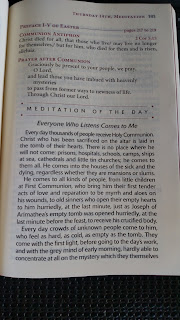


"I especially like this part: "In the eyes of the world they are without importance, but in fact, because of them and their unemotional Communions, when the world seems to be finished, given up to hatred and pride, secretly, in unimaginable humility, Love comes to life again.  There is resurrection everywhere."

You can find the whole Meditation in Magnificat, April 2016, Vol. 18, No. 2, pages 185-186

Wednesday, November 6, 2013

Blessed Is She Who Has Believed

USCCA, Chapter 12
Re Mary

I joyfully and gratefully recognize the sacramental relationship between Eve, Israel, Mary, Church, and yes, me!  God wants my fiat too! 

  45 And blessed is she who believed that there would be[e] a fulfillment of what was spoken to her by the Lord.”

Thank You, Lord, for all the ways You bring us Christ.  Thank You especially for Mary's profound and complete willingness to be Your "handmaid".  Her perfect trust in You both humbles and nourishes me. 

Hail Mary, full of grace!  The Lord is with thee.  Blessed art thou amongst women, and blessed is the fruit of thy womb, Jesus!

And blessed am I because of your Yes to God! :)

Four Marks

Four Marks

USCCA, Chapter 11
The four marks of The Church are:
One
Holy
Catholic
Apostolic

1st, by "The Church," we mean the entire Body of Christ, not just Roman Catholics.
2nd, by "Catholic" we mean "universal;"  this makes the first point clear.

I think that recognizing, acknowledging, and embracing the Truth of these "four marks" gives us a great context of humility!  If we really believe we ARE One, Holy, Universal, and connected with the First Believers, how could be act disrespectfully toward one another?

Wednesday, May 23, 2012

Faithfulness is powerful!

Re-reading the GIRM (General Instruction for the Roman Missal).  It seems to me there isn't much changed in the GIRM, even though the translation for the prayers, etc. are changed in the RM.  Even so, this is a manual I should re-read at least once-a-year!  There's so much to know!  Even so, what most amazes me is how well we do liturgy together even though most of us don't know the GIRM, not even the parts that pertain to our own specific ministry.  I think that testifies to the power of example and tradition.  It also goes to show that all those who make it their business to correct us along the way have a very important ministry too: that of keeping the faith, in more ways than one!  It's true, it doesn't take a degree to do liturgy well.  It doesn't take a degree or even a manual to teach and follow a plan.  It does however take great personal humility as well as devotion to the Lord to remain true, in this case true to "Lex Orandi, Lex Credendi, Lex Vivendi" in its deepest sense.  Thanks be to God for Jesus Christ; thanks be to Jesus for the Holy Spirit; thanks be to the Spirit of becoming One! :)

Friday, April 20, 2012

The Way of a Pilgrim
written in the 19th century
by an anonymous writer, (Russian traveler? Greek monk?), someone fairly knowledgeable.
Setting is Russia.
Ideas taken from Orthodox Christian tradition, particularly the Philokalia, which advocates the ideas of hesychasm;
Focus of The Way of a Pilgrim is prayer, constant prayer, particularly using "the Jesus Prayer" as a mantra.
The experiences described by the Pilgrim is resonant of Tolstoy and Dostoevsky.
J.D. Salinger used The Way of a Pilgrim in his Fanny and Zooey.

This sounds like a book I would enjoy reading immensely.

Monday, April 9, 2012

Little Flowers

from Russell's Spiritual Classics:

The Little Flowers of St. Francis

Who:  Anonymous
What:  stories of Saint Francis and others of his "motley crew" !
Where:  Italy
When:  14th century
How:  originally in Umbrian?
Why:  accounts of the early Franciscan movement

As regards St. Francis, I've only yet read Chesterton's work.  I look forward to getting a copy of the Little Flowers; I'm sure I will treasure it.  There are many editions from which to choose!

Thursday, April 21, 2011

Chesterton's Francis

I'm reading G. K. Chesterton's Saint Francis of Assisi (with an introduction by Joseph Pearce).  Here's an excerpt from Pearce's introduction:

The admiration that Chesterton felt towards St. Francis was inextricably bound up with his belief in the superiority of childlike innocence over all forms of cynicism.  St. Francis and his followers were called the Jongleurs de Dieu because of the innocence of their jollity and the jollity of their innocence.  'The jongleur was properly a joculator or jester; sometimes he was what we should call a juggler.'  It was this mystical synthesis of laughter and humility, a belief that playing and praying go hand in hand, which was the secret of the saint's success.  Ultimately, however, the laughter and the humility were rooted in gratitude because, as Chesterton discerned with characteristic and Franciscan sagacity: 'There is no way in which a man can earn a star or deserve a sunset.'

I too believe childlike innocence is far superior to cynicism, that playing and praying go hand in hand, and that we can be grateful for all things, especially as we know all things come through Our Father's loving hands.